Why Long-Form Journalism Still Matters in the Age of Short Attention Spans
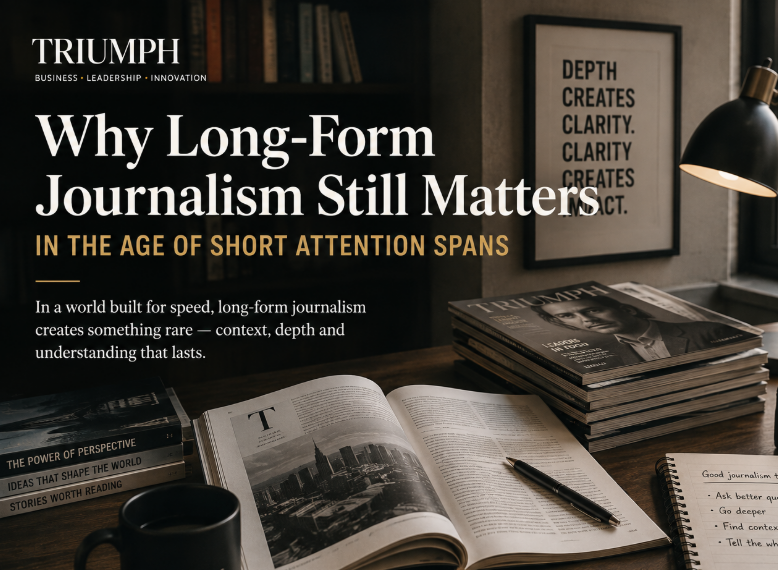
We live in a world built for speed.
News arrives in seconds. Headlines compete for attention. Social feeds refresh endlessly. A video can explain an idea in thirty seconds, and a notification can interrupt a thought before it has fully formed.
In this environment, long-form journalism can seem almost out of place.
Why would someone spend fifteen minutes reading an investigation when a summary can be consumed in less than a minute?
Why read an interview of 3,000 words when a short clip can capture the most memorable quote?
Why spend time understanding a complicated issue when the internet can provide an opinion almost instantly?
The answer is simple.
Because some stories cannot be understood in thirty seconds.
Information Is Everywhere. Understanding Is Not.
The internet solved one enormous problem.
It made information accessible.
But it created another.
There is now more information available than any individual can reasonably process.
A major event can generate thousands of headlines, posts, videos and opinions within hours.
The reader is surrounded by information but often lacks context.
Long-form journalism occupies an important space in that environment.
It slows the story down.
It asks questions.
It connects events.
It provides background.
It allows different perspectives to be examined.
Most importantly, it gives the reader enough information to form an opinion rather than simply inherit one.
The Value of Taking Time
Some subjects are naturally complicated.
A company’s transformation cannot always be explained through a headline.
A political development may have decades of history behind it.
An entrepreneur’s success may involve years of failure that never appear in a social media post.
A cultural movement may have causes that stretch far beyond the event currently receiving attention.
Long-form journalism gives these stories room to breathe.
Instead of asking:
“What happened?”
it can ask:
“Why did it happen?”
And then:
“What happens next?”
That difference is enormous.
The Interview That Goes Beyond the Quote
Interviews are a good example.
Digital media often rewards the most dramatic sentence from a conversation.
A powerful quote can become a headline.
A controversial statement can become a viral clip.
But a person’s story is rarely contained in one sentence.
A thoughtful interview can reveal how someone thinks, what shaped their decisions, what they regret and what they believe about the future.
The pauses matter.
The contradictions matter.
The context matters.
A long-form interview allows the reader to meet the person rather than simply consume a quote from them.
For a magazine, this remains one of the most powerful editorial formats.
The Lost Art of Context
One of the greatest strengths of long-form journalism is context.
Imagine reading:
“Company X announces major expansion.”
That is information.
But a deeper story might ask:
Why is the company expanding now?
What has changed in its industry?
Who are its competitors?
What risks does the company face?
How has the organisation evolved?
What does the expansion mean for employees and customers?
What could happen next?
The first version tells you what happened.
The second helps you understand why it matters.
That is the difference between information and journalism.
Attention Is Not the Enemy
The phrase “short attention span” is often used to describe modern audiences.
But perhaps the problem is not that people have stopped paying attention.
Perhaps people have become selective about what deserves their attention.
People will still spend hours watching a compelling film.
They will still read an absorbing novel.
They will still listen to a fascinating podcast for two hours.
They will still explore a subject when they genuinely care about it.
The challenge for publishers is therefore not simply to make everything shorter.
It is to make something worth staying for.
A great long-form article should earn the reader’s time.
Storytelling Makes Complexity Accessible
Long-form journalism does not have to be difficult to read.
In fact, the best long-form writing often feels effortless.
A complex subject can become accessible through storytelling.
Instead of presenting statistics one after another, a journalist might introduce a person affected by the issue.
Instead of explaining an industry entirely through corporate statements, they might follow someone working inside it.
Instead of presenting history as a list of dates, they might reconstruct the decisions and personalities that shaped it.
Storytelling gives information a human dimension.
And humans remember stories.
The Importance of Original Reporting
Another reason long-form journalism matters is that it can produce information rather than simply repeat it.
The internet is excellent at distribution.
But distribution is not the same as reporting.
Original journalism requires research, interviews, verification and editorial judgment.
It can involve months of investigation before a reader sees a single paragraph.
That work often happens invisibly.
The reader sees the finished story.
They may never see the dozens of conversations, documents, revisions and questions behind it.
But that work is precisely what gives serious journalism its value.
Long-Form Journalism Builds Trust
Trust is increasingly difficult to establish in a crowded information environment.
Readers encounter sponsored content, influencers, anonymous accounts, algorithmic recommendations, automated summaries and countless competing opinions.
A publication’s reputation therefore becomes increasingly important.
Long-form journalism can strengthen that relationship because it demonstrates effort.
The reader can see the depth of the reporting.
They can understand the evidence.
They can follow the argument.
They can encounter perspectives that challenge their assumptions.
Good journalism does not ask readers to agree with everything.
It asks them to think more carefully.
The Magazine Has a Unique Role
This is where magazines have an interesting advantage.
Daily news organisations are often structured around immediacy.
Magazines can operate differently.
They can look beyond the immediate headline.
They can identify themes.
They can revisit important subjects after the initial attention has disappeared.
They can dedicate space to people, ideas and stories that may not fit comfortably into a fast-moving news cycle.
That gives magazines an opportunity to become places of perspective.
Not simply:
“What happened today?”
But:
“What does this moment mean?”
The Digital Long Read
Long-form journalism has also found a new home online.
Digital publishing removes many of the physical limitations of print.
An article can include photography, video, audio, graphics, documents and interactive elements.
A reader can move through a story at their own pace.
They can explore related material without leaving the publication.
The result can be something more immersive than either a traditional article or a traditional magazine page.
The digital long read is therefore not simply an old format moved onto a screen.
It can be a new form of storytelling.
AI Makes Human Journalism More Important
The growth of artificial intelligence makes this conversation even more relevant.
AI systems can summarise information in seconds.
They can produce explanations, rewrite text and generate enormous quantities of content.
That makes basic information increasingly abundant.
But it also raises a question:
If everyone can generate information, what makes information valuable?
The answer may increasingly be originality, credibility, experience and human perspective.
AI can summarise what is already known.
Journalists can go somewhere.
They can ask someone a difficult question.
They can uncover something that was not previously public.
They can notice contradictions.
They can investigate.
They can decide which detail matters.
Those qualities become more valuable—not less—in an environment overflowing with automatically generated material.
A Different Relationship With Time
Perhaps the greatest value of long-form journalism is that it asks the reader to do something increasingly rare:
Stop.
Stop scrolling.
Stop switching between applications.
Stop reacting.
Spend time with one idea.
Follow an argument.
Meet a person.
Understand a subject.
That experience can feel almost luxurious in a world designed around constant interruption.
And perhaps that is exactly why it matters.
The Future Is Not Necessarily Shorter
Publishing does not have to choose between short and long.
Both have their place.
A headline can tell us something happened.
A short article can explain the basics.
A video can capture emotion.
A podcast can create intimacy.
And a long-form feature can help us understand the bigger picture.
The future of journalism will likely involve all of these formats working together.
The question is not whether long-form journalism can compete with short-form content.
It does not need to.
They serve different purposes.
Stories Worth Staying For
The world is becoming faster.
That is precisely why depth matters.
When information moves quickly, context becomes valuable.
When opinions multiply, evidence becomes important.
When content becomes abundant, curation becomes meaningful.
And when attention becomes scarce, stories worth spending time with become more powerful.
Long-form journalism survives not because readers have unlimited attention.
It survives because some stories are worth giving our attention to.
The format may change.
The screen may replace the page.
Photography may be joined by video and audio.
The way readers discover stories will continue to evolve.
But the fundamental purpose remains.
To slow down long enough to understand something that matters.
And in an increasingly noisy world, that may be one of the most valuable things a magazine can offer.