Beyond Chatbots: The Rise of AI Agents in the Modern Workplace
Suggested reading time: 7–8 minutes
For the past few years, artificial intelligence in the workplace has largely meant one thing: chat.
Employees ask questions. AI writes emails. Documents are summarised. Ideas are generated. Code is drafted. Information is retrieved in seconds.
But a more consequential shift is now taking shape.
The next generation of workplace AI is not simply waiting for instructions inside a chat window. AI agents are increasingly being designed to understand goals, plan tasks, use software and complete multi-step workflows.
That changes the conversation entirely.
The future of workplace AI may not be about having a smarter chatbot.
It may be about having an AI workforce.
From Answering Questions to Taking Action
A traditional chatbot is largely reactive.
You ask it something, and it gives you an answer.
An AI agent is designed to operate differently. Give it a goal and, depending on its permissions and design, it can determine the steps required to reach that goal and interact with connected systems along the way.
Consider a simple example.
A sales employee might currently ask an AI assistant:
“Write a follow-up email for this customer.”
The employee reviews the email, copies it into their email platform, sends it, updates the CRM and creates a reminder for the next follow-up.
An agent-based system could potentially handle much more of that workflow.
It could review the customer record, analyse previous conversations, prepare a personalised message, update the CRM and schedule the next action—with a human approving the important steps.
The difference is subtle in appearance but enormous in consequence.
AI moves from generating content to performing work.
Why Businesses Are Paying Attention
The attraction is obvious.
Modern organisations contain thousands of repetitive processes.
Invoices need to be reviewed.
Customer requests need to be categorised.
Reports need to be prepared.
Meetings need to be summarised.
Data needs to move between systems.
Potential customers need to be researched.
Employees need information from multiple databases.
Much of this work requires intelligence, but not necessarily human attention at every stage.
That makes it a natural target for AI agents.
Google Cloud’s 2026 research on AI business trends identifies the movement toward agentic workflows as one of the major developments shaping enterprise AI. IBM similarly describes agentic AI as a model in which agents can plan and execute multi-step tasks while working alongside people.
The appeal is not simply automation.
It is autonomous coordination.
The Office Could Become a Network of Agents
Imagine a typical company five years from now.
A customer submits a request.
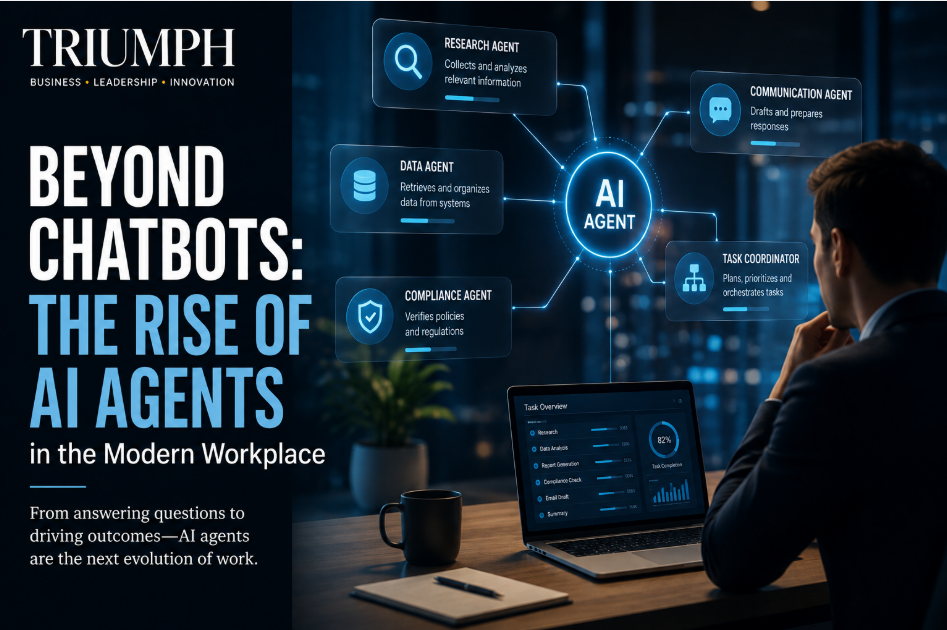
An AI service agent understands the request and determines what information is needed.
A research agent gathers the relevant customer history.
A data agent checks internal systems.
A compliance agent verifies whether the proposed action meets company rules.
A communication agent prepares the response.
A human employee reviews the final recommendation.
What previously required several people, applications and manual handoffs could become a coordinated digital workflow.
This does not mean humans disappear from the process.
Instead, humans may increasingly move up the chain of responsibility.
Rather than manually performing every step, employees may supervise systems that perform the steps.
That creates a fundamentally different workplace.
The End of the Traditional Software Workflow?
For decades, businesses have operated through applications.
Employees open an email application.
Then a CRM.
Then a spreadsheet.
Then a project management system.
Then a database.
Then another application.
The employee becomes the connection between these systems.
AI agents could change that relationship.
Instead of employees constantly moving between software platforms, agents could increasingly move information between systems on their behalf.
The interface could become less about where the information lives and more about what outcome the employee wants.
Instead of:
“Open the CRM, find the customer, check their order, open the support ticket and prepare a response.”
The instruction could eventually become:
“Find out why this customer’s order was delayed and resolve the issue if it falls within our policy.”
The AI handles the workflow.
The employee handles the judgment.
But Autonomy Has a Price
The promise of AI agents comes with an important warning.
The more an AI system can do, the more carefully its actions must be controlled.
A chatbot that produces an incorrect paragraph is inconvenient.
An AI agent that incorrectly changes a customer’s account, approves a payment or sends sensitive information could create a much more serious problem.
This is why enterprise adoption cannot be based purely on capability.
Companies need:
- Clearly defined permissions
- Human approval for high-risk decisions
- Reliable data
- Audit trails
- Security controls
- Monitoring
- Strong governance
- Clear accountability
The question should never simply be:
“Can the AI do this?”
It should also be:
“Should the AI be allowed to do this without a human?”
That distinction will become one of the defining management questions of the AI era.
The New Role of Employees
The rise of AI agents will also force organisations to rethink job descriptions.
An employee whose day once consisted of researching, compiling information and preparing reports may increasingly spend their time reviewing AI-generated analysis, identifying exceptions and making decisions.
A customer-service representative may handle fewer routine requests but become more involved in complex customer situations.
A marketing professional may spend less time producing individual pieces of content and more time developing strategy, positioning and creative direction.
The value of the employee shifts.
Execution becomes increasingly automated. Judgment becomes increasingly important.
Microsoft’s 2026 research on the future of work similarly highlights how AI is changing not only productivity but the way people organise and collaborate at work.
This could make some roles smaller.
But it could also make others significantly more strategic.
The Manager’s Job Will Change Too
One of the most overlooked consequences of agentic AI is what it could mean for management.
Managers traditionally coordinate people.
They distribute tasks.
They check progress.
They review outputs.
They resolve bottlenecks.
They make sure information reaches the right person.
If AI agents begin performing some of these coordination functions, managers may need to focus more heavily on direction, judgment and people.
The manager of the future may oversee a combination of human employees and digital agents.
That raises a fascinating possibility:
What happens when a manager has ten employees and fifty AI agents working for the team?
The answer will probably not be found in traditional management textbooks.
Organisations will have to invent new models.
The Data Problem
There is, however, one major obstacle that often receives less attention than the AI itself.
Agents need access to information.
An intelligent agent cannot effectively make decisions if the company’s data is fragmented, outdated or unreliable.
A business may have excellent AI technology but still struggle because customer information exists across disconnected systems, documents are poorly structured and internal processes are inconsistent.
This means the AI revolution is also becoming a data and infrastructure revolution.
Companies that want autonomous AI systems will need to know what information exists, where it lives, who can access it and whether it can be trusted.
The smarter the agent becomes, the more important the quality of its environment becomes.
Smaller Companies Could Benefit Too
Agentic AI is not necessarily a story only for multinational corporations.
Smaller businesses may have an interesting advantage.
Large organisations often have complex legacy systems and layers of internal processes. Smaller companies may be able to redesign workflows more quickly.
A small company could potentially use AI agents to handle portions of research, customer support, administration, marketing and reporting without building enormous teams for each function.
This could allow small businesses to operate with capabilities that previously required much larger organisations.
The result could be a new kind of competitive environment:
small teams with enormous digital leverage.
The Human Agent Behind the AI Agent
There is an irony at the centre of the AI-agent revolution.
The more autonomous AI becomes, the more important human responsibility may become.
Someone still needs to define the objective.
Someone needs to establish the boundaries.
Someone needs to determine what success looks like.
Someone needs to decide when the machine should stop.
And someone ultimately needs to be accountable when things go wrong.
The future therefore isn’t necessarily one in which humans hand everything over to machines.
It may be one in which humans become architects of intelligent systems.
The Beginning of the Agentic Workplace
We are still early in this transition.
Many AI-agent deployments remain experimental. Businesses are still learning where autonomy creates genuine value and where human oversight is essential.
But the direction is becoming increasingly clear.
The workplace is moving from AI that answers to AI that can increasingly act.
From assistants to agents.
From individual prompts to coordinated workflows.
From software that waits for instructions to systems capable of pursuing defined objectives.
The companies that understand this shift early will have an opportunity to redesign work before the change becomes unavoidable.
And the biggest question will not be whether AI agents are capable enough.
It will be whether organisations are prepared to trust them responsibly.
Because the future of work may not be a workplace without people.
It may be a workplace where people decide what matters—and intelligent machines handle much of the work required to make it happen.