
India’s AI Moment: Can the Country Become an Innovation Powerhouse?
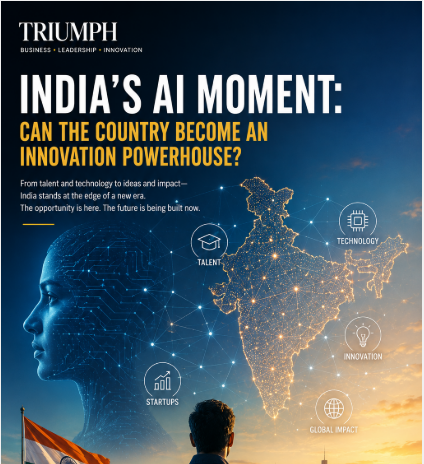
India has spent decades building a reputation as one of the world’s major technology and services hubs.
Now, the country faces a different opportunity.
Artificial intelligence is changing how companies build products, deliver services, analyse information and compete globally. For India, this is more than another technology cycle. It could become an opportunity to move from being a major consumer and implementer of technology to becoming a creator of globally influential AI products, platforms and businesses.
The question is no longer whether India will participate in the AI revolution.
It is whether India can shape it.
From IT Powerhouse to AI Powerhouse
India’s technology story was built largely around software services, engineering talent and global outsourcing.
That model created enormous value.
Indian technology companies became critical partners for businesses around the world, while millions of professionals built careers around software development, consulting, analytics and IT services.
Artificial intelligence introduces a new possibility.
Instead of primarily building technology for other companies, Indian businesses can increasingly build technology products of their own.
The distinction matters.
A services company is often paid to solve a client’s problem.
A product company can solve a problem once and potentially serve millions of customers.
AI dramatically lowers some of the barriers between these two models.
A small team with strong technical talent can now build sophisticated software with capabilities that once required much larger engineering organisations.
That creates an opportunity for India’s entrepreneurial ecosystem.
India’s Biggest Advantage: Talent
India’s strongest advantage may not be computing infrastructure.
It may be people.
The country produces a large pool of engineers, developers, researchers and technology professionals every year. Indian professionals are also deeply integrated into global technology companies.
But talent alone is not enough.
The next phase requires moving from technical execution to technological invention.
That means encouraging more people to build foundational technologies, specialised AI applications, research platforms and global products.
It also means changing how success is measured.
India’s technology sector has historically been exceptionally good at solving problems for clients.
The AI era could reward companies that identify problems the world has not yet solved—and build products around them.
The Rise of the AI-Native Company
One of the most interesting developments in the AI economy is the emergence of companies designed around AI from the beginning.
These organisations do not simply add AI to an existing workflow.
AI is part of the business model itself.
An AI-native company might use intelligent systems to develop products, serve customers, analyse markets, write software and automate internal operations from day one.
This can dramatically reduce the amount of infrastructure required to build a business.
For Indian entrepreneurs, that could be significant.
A founder in Bengaluru, Pune, Hyderabad or Delhi can potentially build a product for a global market without first establishing a large international organisation.
The market is global from the beginning.
India Needs More Than AI Adoption
There is an important difference between using AI and building the AI economy.
Indian businesses are rapidly adopting AI across functions such as operations, marketing, product development and strategy. Deloitte’s 2026 research found that 40% of surveyed Indian enterprises reported significant or full AI usage, compared with about 28% globally.
That is encouraging.
But adoption is only one part of the story.
For India to become an innovation powerhouse, it also needs:
Research.
Infrastructure.
Capital.
Entrepreneurship.
World-class products.
Global distribution.
Strong intellectual property.
The country must build the ecosystem around AI, not simply consume the technology.
The Infrastructure Challenge
AI requires enormous amounts of computing power and data.
Training advanced models can require specialised chips, large data centres and significant amounts of electricity.
India therefore faces a major infrastructure question.
Can the country build enough computing capacity to support the next generation of AI businesses?
And can that infrastructure be made accessible enough for startups, researchers and smaller companies?
The answer will influence how quickly India’s AI ecosystem can develop.
Infrastructure is not merely a technical concern.
It is becoming a strategic economic asset.
Countries that control access to advanced computing will have greater influence over the development of future technologies.
The Opportunity Beyond Chatbots
It is easy to think of AI as synonymous with conversational assistants.
But the larger opportunity is much broader.
AI can transform:
Healthcare through diagnostic support and personalised treatment research.
Agriculture through crop monitoring, forecasting and precision farming.
Manufacturing through predictive maintenance and intelligent production systems.
Financial services through fraud detection, risk analysis and automated operations.
Education through personalised learning.
Logistics through intelligent routing and demand forecasting.
Public services through better data analysis and citizen-facing systems.
India’s scale makes these applications particularly interesting.
A solution that works across India’s enormous and diverse population can potentially become a solution for other emerging markets.
That could become one of India’s biggest strategic advantages.
India’s Diversity Could Become a Technology Advantage
India is not a single market.
It is hundreds of markets operating within one country.
Multiple languages.
Different levels of digital literacy.
Urban and rural populations.
Different economic conditions.
Different cultural contexts.
This complexity creates challenges for technology companies.
But it can also create an extraordinary testing environment.
AI systems that can effectively operate across India’s linguistic, cultural and economic diversity could eventually become valuable in other developing markets.
The opportunity therefore extends beyond building AI for India.
It could mean building AI from India for the world.
The Language Opportunity
Language is one particularly interesting area.
India’s population speaks hundreds of languages and dialects, while much of the world’s AI infrastructure has historically been dominated by English and a relatively small group of major languages.
Developing systems that understand India’s linguistic diversity could unlock enormous possibilities in education, healthcare, government services, commerce and financial inclusion.
This is not simply a translation problem.
Language carries context, culture and intent.
An AI system that genuinely understands local languages could make digital technology accessible to people who have historically been underserved by it.
That could turn India’s diversity from a challenge into a competitive advantage.
The Startup Question
India already has a large startup ecosystem.
But the AI era may change what makes a startup successful.
Traditional software startups often required significant engineering teams, sales organisations and operational infrastructure before they could scale.
AI can reduce some of those requirements.
A small team can potentially automate internal operations, accelerate development and reach international customers faster.
That could lead to a new generation of small but globally ambitious Indian companies.
The challenge will be funding.
Building serious AI companies can still require significant investment, particularly when computing infrastructure, research and specialised talent are involved.
India will need investors willing to support long-term technology development rather than focusing exclusively on rapid short-term returns.
The Education Challenge
If AI changes the nature of work, education must change with it.
Teaching people how to use specific software will not be enough.
Students will increasingly need to understand:
- How AI systems work
- How to evaluate AI-generated information
- How to work alongside intelligent systems
- How to solve problems creatively
- How to communicate effectively
- How to make decisions under uncertainty
The most valuable education may increasingly be the education that machines cannot easily replicate.
Critical thinking.
Creativity.
Judgment.
Curiosity.
Communication.
Leadership.
Technical understanding.
India has an enormous young population.
That makes education one of the country’s biggest AI opportunities—and one of its biggest risks if the transformation is ignored.
From Talent Exporter to Innovation Builder
For decades, India has exported technology talent.
The next chapter could be different.
Instead of Indian engineers primarily joining global companies, more could build global companies themselves.
Instead of Indian technology companies primarily delivering services, more could develop intellectual property.
Instead of India being known mainly for its software workforce, it could increasingly become known for its technology companies.
That transition will not happen automatically.
It requires ambition.
The Global Opportunity
India’s domestic market is enormous.
But the most successful AI companies will increasingly think globally from the beginning.
An Indian company building an AI platform for healthcare, finance, logistics or enterprise software does not necessarily need to limit itself to the Indian market.
The same technology could potentially serve customers in Southeast Asia, Africa, the Middle East, Europe and North America.
This is where India’s combination of technical talent, entrepreneurial energy and relatively cost-efficient engineering could become powerful.
The opportunity is not simply to become the world’s back office for AI.
It is to become one of the world’s innovation centres.
The Road Ahead
India’s AI opportunity is enormous.
But opportunity is not destiny.
The country will need to solve difficult problems around infrastructure, research funding, education, regulation, intellectual property and access to capital.
It will also need to encourage a culture that rewards experimentation.
Not every AI startup will succeed.
Not every model will work.
Not every investment will pay off.
Innovation inevitably involves failure.
The countries that benefit most will be those willing to experiment repeatedly.
India’s AI Moment
The defining question for India is therefore not whether it has enough engineers.
It is whether it can turn engineering talent into innovation at scale.
The country has already demonstrated that it can compete globally in technology services.
The next challenge is harder.
Build the products.
Own the intellectual property.
Create the platforms.
Fund the research.
Develop the talent.
And take those innovations to the world.
The AI revolution is still in its early stages.
That means the winners have not yet been completely decided.
For India, that may be the most important opportunity of all.
The country does not have to wait for the future to arrive. It has an opportunity to help build it.