The Evolution of the Magazine: From Print Pages to Digital Experiences
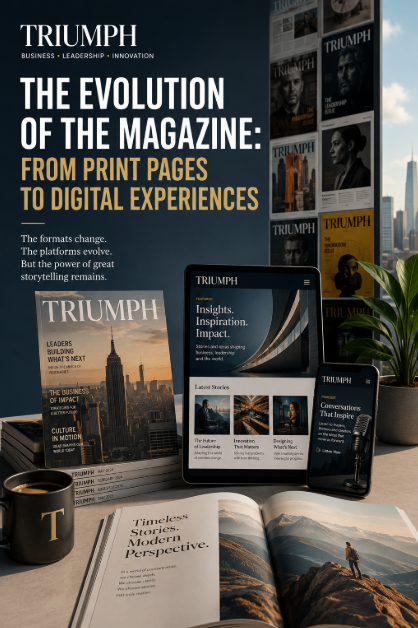
There was a time when a magazine was something you held in your hands.
It arrived on a newsstand, sat on a coffee table or appeared in the mailbox. Its pages had weight. Its photographs had texture. Its cover competed for attention among dozens of others.
Today, the magazine exists almost everywhere.
On a phone screen. Inside a browser. In an email inbox. Across social media. Through podcasts, videos, newsletters and live events.
Yet despite all of these changes, one thing has remained remarkably consistent:
People still want stories worth their attention.
The magazine industry has not disappeared.
It has evolved.
From the Newsstand to the Screen
For much of the 20th century, magazines were built around a relatively simple relationship.
Publishers created content.
Readers bought publications.
Advertisers paid for access to those readers.
The physical magazine was the product, the distribution channel and the brand experience all at once.
The arrival of the internet disrupted that model.
Readers suddenly had access to information without waiting for the next issue. News moved from weekly and monthly cycles to minutes and seconds. Advertising shifted toward digital platforms. Publishers began experimenting with websites, online editions and eventually social media.
The magazine was no longer defined by paper.
It became defined by content, identity and audience.
That change was disruptive—but it also created possibilities that print alone could never offer.
The Magazine Became a Living Brand
A printed issue has a beginning and an end.
A digital publication does not.
A story can be updated. A reader can share it instantly. An interview can become a video. A photograph can become a social post. A feature can generate a podcast discussion.
The modern magazine is therefore increasingly becoming something larger than an individual publication.
It becomes a media brand.
Consider what a modern editorial brand can offer:
- Long-form articles
- Digital magazines
- Interviews
- Podcasts
- Video
- Newsletters
- Social media
- Events
- Special reports
- Communities
Each format can reinforce the others.
The story is no longer restricted to a page.
The story becomes an experience.
But Print Is Not Dead
Digital transformation did not eliminate the appeal of physical magazines.
In some ways, it made the physical product more valuable.
When people are surrounded by endless digital content, something tangible can feel special.
A beautifully designed magazine can be collected.
A striking cover can become an object.
High-quality photography can feel different on paper.
Long-form journalism can be experienced without notifications appearing every few seconds.
This is one reason premium print continues to occupy a distinctive position within the broader publishing landscape.
Print is no longer necessarily the only format.
It can be the premium format.
The physical edition becomes part of the brand rather than the entire brand.
The Cover Still Matters
Few elements of magazine publishing have retained as much cultural power as the cover.
A good cover does more than announce an issue.
It creates curiosity.
It establishes a visual identity.
It communicates a point of view.
And sometimes, it becomes part of popular culture itself.
The best covers are instantly recognisable even without explanation.
That is because magazine design has always understood something that digital media sometimes forgets:
People don’t just consume information. They respond to presentation.
Typography, photography, colour, composition and editorial judgment all contribute to how a story is perceived.
In a world filled with algorithmically generated content, thoughtful design may become even more important.
The Battle for Attention
The biggest challenge facing magazines today is not necessarily competition from other magazines.
It is competition from everything.
A reader can move from a news article to a short video, from a social post to a podcast, from an email to a streaming platform—all within minutes.
Attention has become one of the world’s most valuable resources.
That creates a difficult question for publishers:
Why should someone spend ten minutes reading this story when they can consume hundreds of pieces of content in the same amount of time?
The answer cannot simply be speed.
Magazines have historically offered something different.
They offer depth, perspective and curation.
The value is not necessarily in being first.
It can be in being thoughtful.
The Return of Editorial Judgment
The internet gave everyone the ability to publish.
That was revolutionary.
But it also created an enormous amount of information.
Readers now face a different problem.
Not:
“Where can I find information?”
But:
“What information deserves my attention?”
This is where editorial judgment becomes important.
A strong magazine does not simply publish everything.
It chooses.
It investigates.
It interviews.
It edits.
It provides context.
It decides which stories matter.
That process creates something increasingly valuable in a world of information abundance:
trust.
The Rise of the Digital Magazine
Digital magazines have also changed what an issue can be.
A digital edition can combine traditional editorial storytelling with multimedia.
Imagine opening an interview and being able to watch the full conversation.
A feature about architecture can include interactive photography.
A business story can link directly to supporting research.
A travel story can include maps, videos and recommendations.
A profile can connect readers to an entire collection of related stories.
The page has become interactive.
The magazine has become multidimensional.
This doesn’t mean that every story needs animation, video or interactive elements.
Sometimes the best digital experience is still simply a beautifully written article with excellent photography.
Technology should enhance the story—not distract from it.
From Readers to Communities
Another major transformation is the relationship between publishers and audiences.
Traditional magazines primarily communicated in one direction.
Publisher → Reader.
Digital publishing has changed that.
Readers can now comment, share, discuss, respond and contribute.
They can become subscribers, followers, event attendees and members of communities built around an editorial brand.
This creates an opportunity for magazines to develop relationships that extend far beyond a single issue.
The strongest publications are no longer simply asking:
“How many copies did we sell?”
They can also ask:
“How deeply are we connected to our audience?”
The Business Model Is Changing
The traditional magazine business depended heavily on advertising and circulation.
Today, publishers have a much broader set of possibilities.
Subscriptions can create recurring revenue.
Premium memberships can provide exclusive content.
Events can bring readers and contributors together.
Branded editorial projects can connect publications with businesses.
Digital products can extend the publication beyond the magazine itself.
Newsletters can build direct relationships with audiences.
The result is a more complex but potentially more resilient publishing model.
The magazine is no longer necessarily a single product.
It can become an ecosystem.
What Happens Next?
The future of magazines will probably not be purely digital or purely physical.
It will be both.
A reader might discover a publication through Instagram, read a feature on its website, subscribe to its newsletter, watch an interview on video, attend an event and eventually purchase a beautifully produced print edition.
Every interaction becomes part of the same editorial relationship.
That is the real evolution.
The magazine is moving from an object to an experience.
From an issue to an ongoing conversation.
From a publication to a brand.
The Magazine Still Has a Future
There is a tendency to describe the history of publishing as a story of replacement.
Print was replaced by websites.
Websites were replaced by social media.
Social media will eventually be replaced by something else.
But perhaps that is the wrong way to look at it.
The magazine has survived because its fundamental purpose was never simply to print pages.
Its purpose was to curate ideas, tell stories and give meaning to the world around us.
The formats will continue to change.
The technology will continue to evolve.
The way readers discover stories will continue to shift.
But the desire for thoughtful journalism, compelling photography, strong opinions and stories about remarkable people will remain.
The magazine of tomorrow may look nothing like the magazine of yesterday.
It may live across screens, paper, audio, video and real-world experiences.
But at its heart, it will still do what great magazines have always done:
Make us stop, look closer and see the world differently.