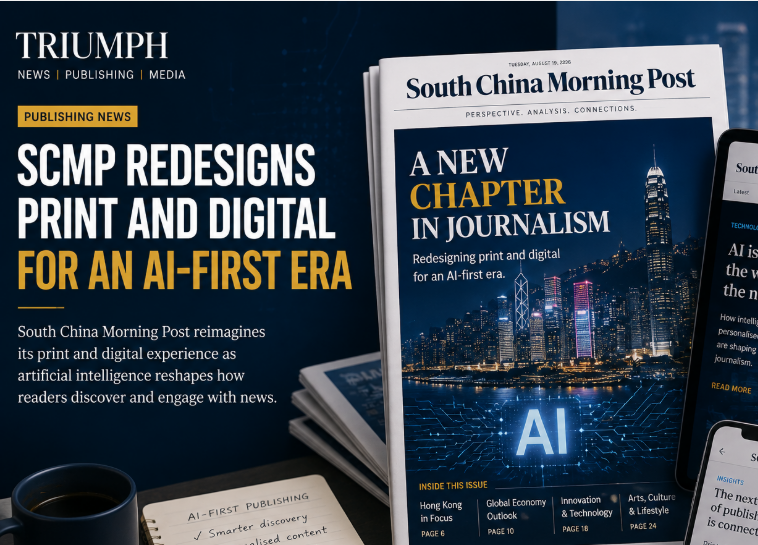
SCMP Redesigns Print and Digital for an AI-First Era
Published: August 19, 2026
Reading time: 4 minutes
The magazine and publishing industry is entering another major period of change as artificial intelligence begins to influence not only how content is produced, but also how publications are designed, distributed and experienced.
One notable example comes from South China Morning Post (SCMP), which has been rethinking both its print and digital products as it prepares for an increasingly AI-driven media environment. The publication’s redesign reflects a broader shift among established media brands toward creating a closer relationship between traditional editorial products and digital experiences.
A New Era for Editorial Design
For decades, print and digital publishing were treated as separate products.
The newspaper or magazine had its own design, production process and audience experience, while the website was built around speed, search and continuous updates.
That distinction is becoming less relevant.
Modern publishers increasingly need their editorial identity to work across paper, websites, mobile screens, social platforms and emerging AI interfaces.
SCMP’s redesign is part of this broader transformation, with the publication adapting its print and digital presentation for an AI-first environment.
AI Is Changing More Than Content Creation
Much of the conversation around AI in publishing has focused on writing.
But the larger transformation could be much broader.
AI can influence how readers discover stories, how publications recommend content, how archives are organised and how information is presented to different audiences.
Instead of every reader receiving exactly the same digital experience, future publications could increasingly personalise how stories are surfaced based on interests and reading behaviour.
For publishers, this creates both an opportunity and a challenge.
The opportunity is greater relevance.
The challenge is maintaining a strong editorial identity while technology increasingly determines what individual readers see.
The Print Edition Still Has a Role
The shift toward AI and digital publishing does not necessarily make print irrelevant.
In fact, it may make the physical edition more distinctive.
Digital platforms are built around speed and constant updates.
Print can offer something different: selection, design and permanence.
A physical edition can deliberately choose the stories that deserve attention rather than attempting to present everything.
That makes editorial design increasingly important.
The cover, typography, photography and page structure become part of the publication’s identity.
The Battle for Reader Attention
Modern publishers are competing against far more than other publications.
They are competing against social media, streaming platforms, newsletters, podcasts, video platforms and AI assistants.
Readers have more choices than ever.
That means publishers need to make every interaction count.
A strong publication needs to answer a simple question:
Why should someone spend their time here?
The answer cannot always be speed.
Sometimes it is expertise.
Sometimes it is access.
Sometimes it is a distinctive point of view.
And sometimes it is simply the quality of the experience.
What AI Means for Magazine Brands
For magazine publishers, the AI era could eventually create a much more connected editorial ecosystem.
A reader might discover a story through an AI assistant, explore the full feature on a publication’s website, watch an interview, receive a related newsletter and later purchase a special print edition.
The publication becomes more than a magazine.
It becomes an editorial platform.
That transformation is already visible across the industry. Publishers are experimenting with new digital products while continuing to invest in print, specialised editions and distinctive editorial experiences.
The Importance of Editorial Identity
Technology can change how stories are distributed.
It cannot automatically create a publication’s identity.
That still comes from editors, writers, photographers, designers and the choices they make about what deserves attention.
This may become even more important as AI-generated content becomes increasingly common.
When readers can receive endless automatically generated information, a trusted editorial brand can become a valuable filter.
The publication’s reputation becomes part of the product.
A New Publishing Model
SCMP’s redesign points toward a larger change taking place throughout the media industry.
The future publication may not be defined by whether it is print or digital.
Instead, it may be defined by how effectively it connects different formats.
Print can provide depth and physical presence.
Digital can provide speed and accessibility.
Video can provide immediacy.
Audio can provide intimacy.
AI can provide discovery and personalisation.
The strongest publishers may be those capable of bringing all of these experiences together without losing the editorial character that made the publication valuable in the first place.
The Next Chapter
The magazine industry has already survived the arrival of television, the internet, social media and smartphones.
AI represents another major disruption—but it does not necessarily signal the end of publishing.
It may instead force publishers to reconsider what they are actually building.
Not simply a magazine.
Not simply a website.
But a relationship between stories, technology and readers.
The next generation of publishing will be defined not by abandoning the past, but by deciding which parts of it are worth carrying forward.
The page may change. The screen may change. The technology may change. But great editorial brands will still be built around one thing: giving readers a reason to come back.