Print Is Not Dead: San Diego Magazine Bets on a New Era of Print
Category: News
Author: Triumph Editorial
Published: August 19, 2026
Reading time: 4 minutes
The magazine industry has spent years adapting to a digital-first world. But one long-running publication is making a notable bet: print still has a future.
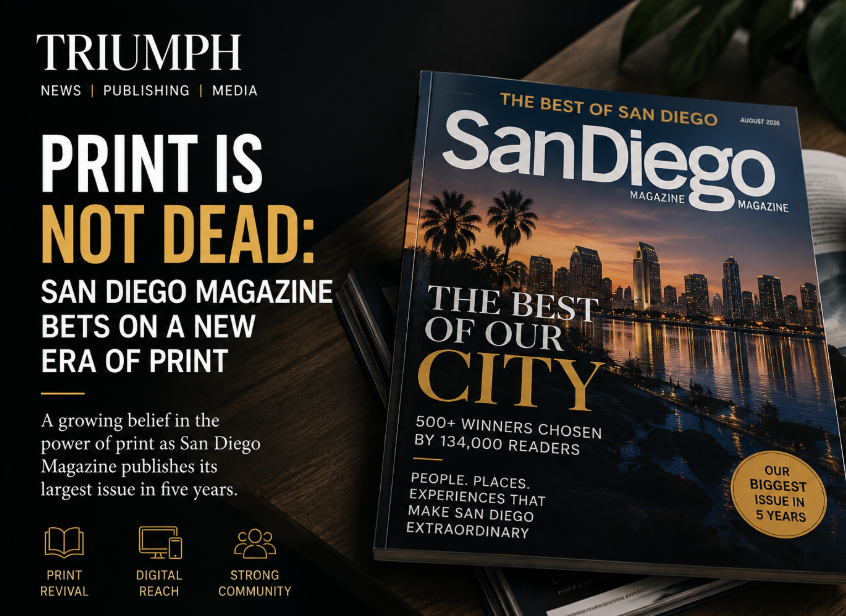
San Diego Magazine, a publication that has been in print since 1948, is placing renewed emphasis on its physical edition under its new editor, Emma Veidt. Its latest “Best of San Diego” issue has the magazine’s largest page count in five years, signalling a renewed confidence in the value of a substantial print product.
A New Generation Reconsidering Print
Veidt, 27, has taken over editorial leadership at a time when publishers continue to navigate the relationship between print and digital media.
Her perspective is particularly interesting because it comes from a generation that grew up surrounded by digital media. Yet she believes there is renewed interest in physical magazines among younger readers.
San Diego Magazine maintains a loyal print subscriber base of around 40,000, alongside a considerably larger digital audience.
The publication’s latest direction suggests that print and digital do not necessarily need to compete.
They can serve different purposes.
Why Physical Magazines Still Matter
A digital article can be accessed instantly and shared around the world.
A physical magazine offers something different.
It is tangible.
It can be collected, displayed and revisited. Its photography, paper quality, typography and physical layout become part of the reading experience.
For premium publications, that experience can also strengthen the relationship between the reader and the brand.
San Diego Magazine’s strategy reflects this idea: maintain a strong digital presence while continuing to invest in a substantial physical publication for an audience that values the print experience.
Print and Digital Are Becoming Partners
The more interesting story may therefore not be a print revival versus digital media.
It may be the emergence of a hybrid publishing model.
A reader might discover a magazine through its website or social media, read its daily digital stories, subscribe to a newsletter and then pick up the physical edition for deeper features and curated content.
The publication becomes an ecosystem rather than a single format.
San Diego Magazine itself already operates across multiple formats, with its website carrying features, guides, podcasts and video alongside its magazine.
The Value of a Bigger Issue
The decision to produce the publication’s biggest issue in five years is also significant.
In a digital environment where content is often designed to be consumed quickly, a larger physical issue communicates something different: there is still value in giving readers something substantial to spend time with.
Its August 2026 edition’s “Best of San Diego” concept also relies heavily on community participation, with nearly 134,000 reader votes helping determine winners across more than 500 categories.
That combination—editorial curation and audience participation—illustrates how modern magazines can make their physical editions feel connected to a much larger digital community.
A Sign of What’s Next for Magazines?
San Diego Magazine’s strategy does not mean the publishing industry is returning to the past.
The future of magazines is likely to be considerably more complicated than simply choosing between paper and screens.
The strongest publications may be those that understand what each format does best.
Digital offers speed, accessibility and reach.
Print offers depth, physicality and permanence.
Together, they can create a stronger editorial brand.
For an industry that has spent much of the past two decades being told that print is disappearing, San Diego Magazine’s latest move offers a different perspective.
Perhaps the future of magazines isn’t about abandoning print.
Perhaps it is about making print worth holding again.